You may have heard the term investor and speculator thrown around before. These terms are commonly used when referring to the amount and the quality of the evidence we utilise before purchasing a stock. So what is the difference between an investor and a speculator?
To dive into this lets look at an analogy of two punters at the Melbourne Cup. There are two individuals; Dave and Greg. Dave loves placing bets at the races while getting on the piss with his mates. He looks at the biggest horse he sees and thinks its going to be a winner. On the other hand there is Greg. Greg meticulously studies the past performance of the horses, the quality of the horses’ trainers and observes each horse during training. Who do you think has a better chance of choosing the right horse? Dave is a speculator and has very little evidence to support why his horse should win while Greg has several pieces of evidence thus showing traits of an investor.
You are probably thinking that surely people don’t invest in stocks like Dave bets on horses. You would be mistaken. While the piece of information for the basis of their purchases may be slightly more significant, it is generally based on a whim. Just because the Australian Financial Review tells you Apple stocks are going bananas doesn’t mean you should buy them. You have to assume all news is “Fake News” until you can prove it.
In saying all of this I don’t think it is clear cut to define someone as a speculator or investor. One way of looking at this is on the simple plot shown below.
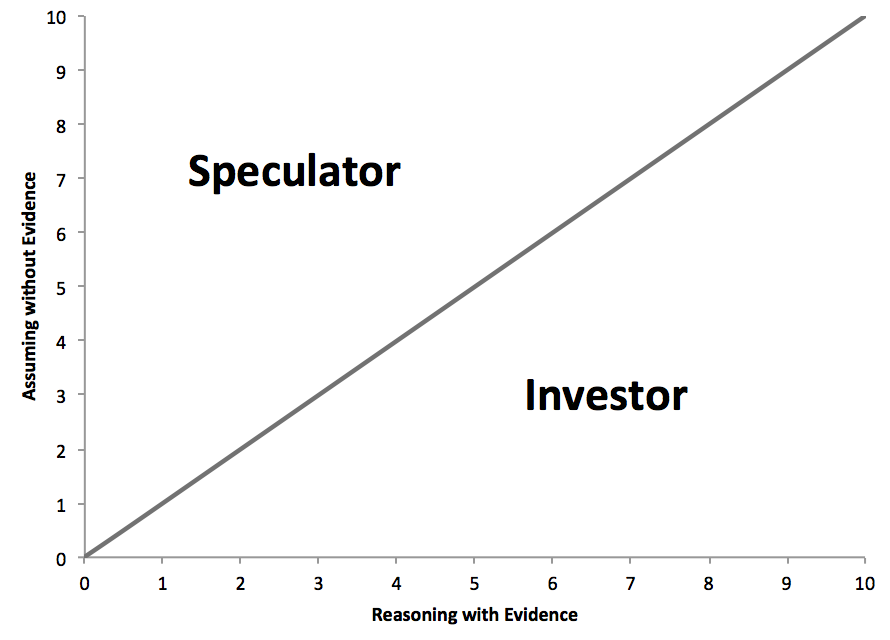
In Figure 1 shown above, we look at what contributes to speculating as opposed to investing. We number each axis from 0 to 10. An ideal investor would base there stock purchase purely on reasoning with evidence; that is their reasoning with evidence is at 10 and their assuming without evidence is at 0. I recommend always staying on the “Investor” side of the curve. This means that for every purchase you make, you have sound reasoning with strong evidence to support your decision. In saying this, everyone tends to speculate a little. It is in our human nature.
Well then, how do we actually become an investor? The answer to this is simple, do the research. So before you go out and buy stocks ask yourself this: “Why am I buying this stock”. If you can’t provide several answers, I recommend that you either don’t make the purchase or start figuring out why.
Jordan Bentley – BEng(Chem)(Hons)/BMath

 The Informed Investor